Final report for YENC25-234
Project Information
Project Summary
This project engaged one family—a youth participant and a parent participant—in applied aquaculture education, watershed stewardship, and natural resource literacy through hands-on learning, professional training, field investigations, and storytelling centered on the remarkable journeys of the Pacific Sockeye Salmon and the Loggerhead Sea Turtle. The project taught water quality, nutrient cycling, watershed relationships, fish biology, mentor species, habitat stewardship, and community resilience while connecting these topics to agriculture, aquaculture, conservation, and natural resource career exploration. George Washington Carver's Creation Awareness method of observing, investigating, experimenting, and applying knowledge before acting became an important educational approach throughout the project and complemented scientific inquiry and watershed stewardship.
The educational approach combined storytelling, mentor species, professional aquaculture education, the Purdue University Youth Aquaculture Educator Workshop curriculum, Yalia's Three-Tank Water Quality Witness, field investigations, watershed mapping, stewardship relationship mapping, reflective journaling, and place-based learning experiences. Educational experiences included Lakota Earthsong, Colorado field investigations at Roaring Judy Hatchery and Bellvue-Watson Hatchery, research related to the Great Salt Lake and Bonneville Cutthroat Trout, and participation in Lakota Spring Harvest Camp. Learning was documented through participant sketches, watershed and stewardship maps, field observations, discussions, project journals, educational products, and successful completion of professional aquaculture education certificates by both participants.
As the project progressed, the educational materials expanded beyond the original activities into the development of the Living Waters Stewardship Operating System (LWSOS), supported through La'SOuL's Living Waters Formation, LLC. The project produced watershed mapping tools, stewardship relationship maps, mentor species learning resources, and educational materials that integrate applied aquaculture education, water quality, watershed literacy, historical interpretation, and stewardship formation. The Miracle of the Quail at Montrose, Iowa, together with personal experience raising quail for eggs and meat, provided additional lessons in provision, self-reliance, food production, and community stewardship.
The project concluded that combining storytelling, scientific observation, professional training, mentor species, and place-based learning provides an engaging approach for teaching aquaculture, watershed stewardship, and natural resource literacy. As a result of the project, the youth participant completed professional aquaculture education, developed observation and mapping skills, and explored agriculture, aquaculture, and conservation pathways. The parent participant adopted and organized these educational experiences into the Living Waters Stewardship Operating System and certified La'SOuL's Living Waters Formation, LLC to support future educational and stewardship initiatives. The project also established educational resources that can be adapted for future learners, families, educators, and community partners.
Empower one family through hands-on aquaponics skill-building, enabling them to design, monitor, and manage small-scale sustainable aquaculture systems focused on water quality, fish care, and nutrient cycling. Facilitate participation in the Aquaculture Challenge to foster teamwork, creativity, and technical skills, while encouraging personal storytelling and Lakota Earthsong connections to aquaculture and conservation. Highlight agriculture careers through mentorship with STEM professionals and leaders, especially for youth interested in agriculture, aquaculture, and conservation careers. Engage students in creating mock business plans emphasizing economic and resource conservation. Host community events to showcase student projects, inspiring local support for sustainable aquaculture and local food initiatives.
Project Objectives
The project sought to empower one family through applied aquaculture education, watershed stewardship, and hands-on learning experiences that strengthened understanding of water quality, fish biology, nutrient cycling, and aquatic ecosystems. The youth participant and parent participant explored professional aquaculture education, field investigations, mentor species, and watershed relationships while developing observation, mapping, and stewardship skills.
The project incorporated participation in the Purdue University Youth Aquaculture Educator Workshop, Yalia's Three-Tank Water Quality Witness, Lakota Earthsong, Colorado field investigations, Roaring Judy Hatchery, Bellvue-Watson Hatchery, Great Salt Lake research, and Lakota Spring Harvest Camp to increase knowledge of aquaculture, fisheries, watershed stewardship, and natural resource management while encouraging exploration of agriculture, aquaculture, conservation, and related career pathways.
Throughout the project, storytelling remained a central educational approach, connecting the miraculous journeys of the Pacific Sockeye Salmon and the Loggerhead Sea Turtle with George Washington Carver's Creation Awareness method, the Miracle of the Quail, mentor species, and watershed stewardship principles. These experiences expanded into the development of the Living Waters Stewardship Operating System (LWSOS), watershed mapping tools, stewardship relationship maps, mentor species learning resources, and educational materials supported through La'SOuL's Living Waters Formation, LLC, providing a foundation for future educational programming in applied aquaculture education, watershed literacy, and community stewardship.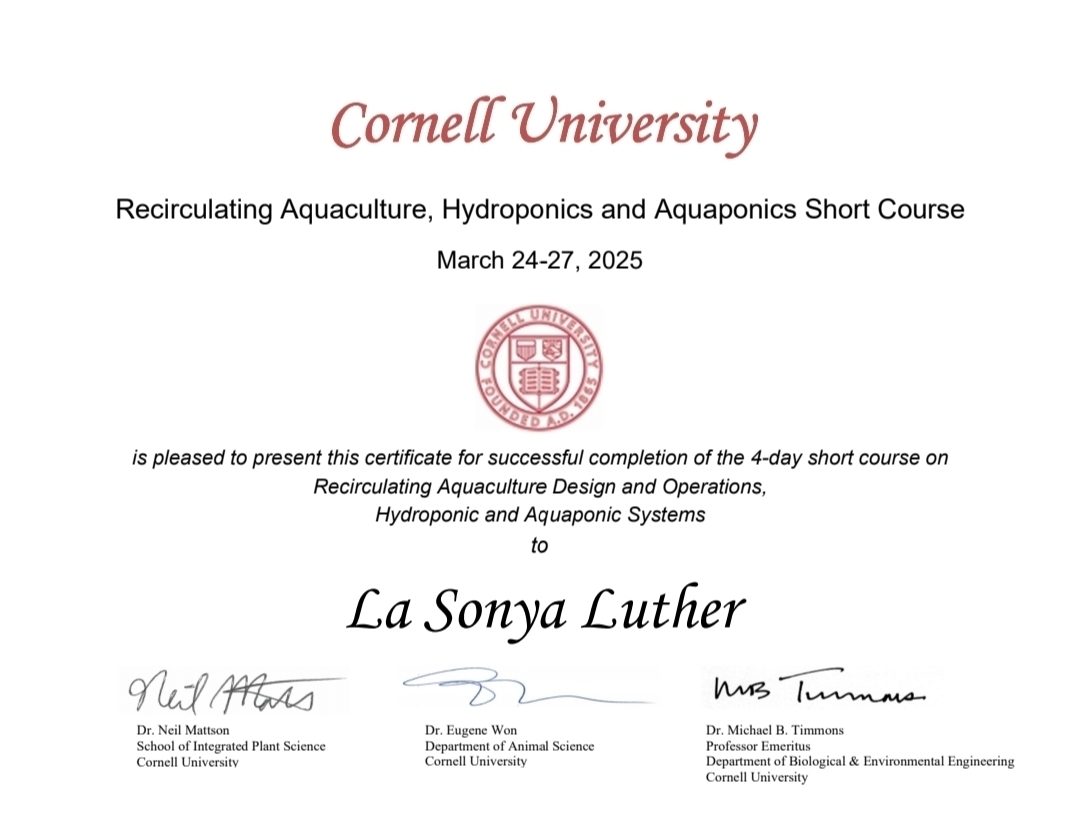
Educational & Outreach Activities
Participation summary:
April 2025–present
During the reporting period, education and outreach activities focused on curriculum development, educator training, and pilot-level youth engagement, rather than full program implementation.
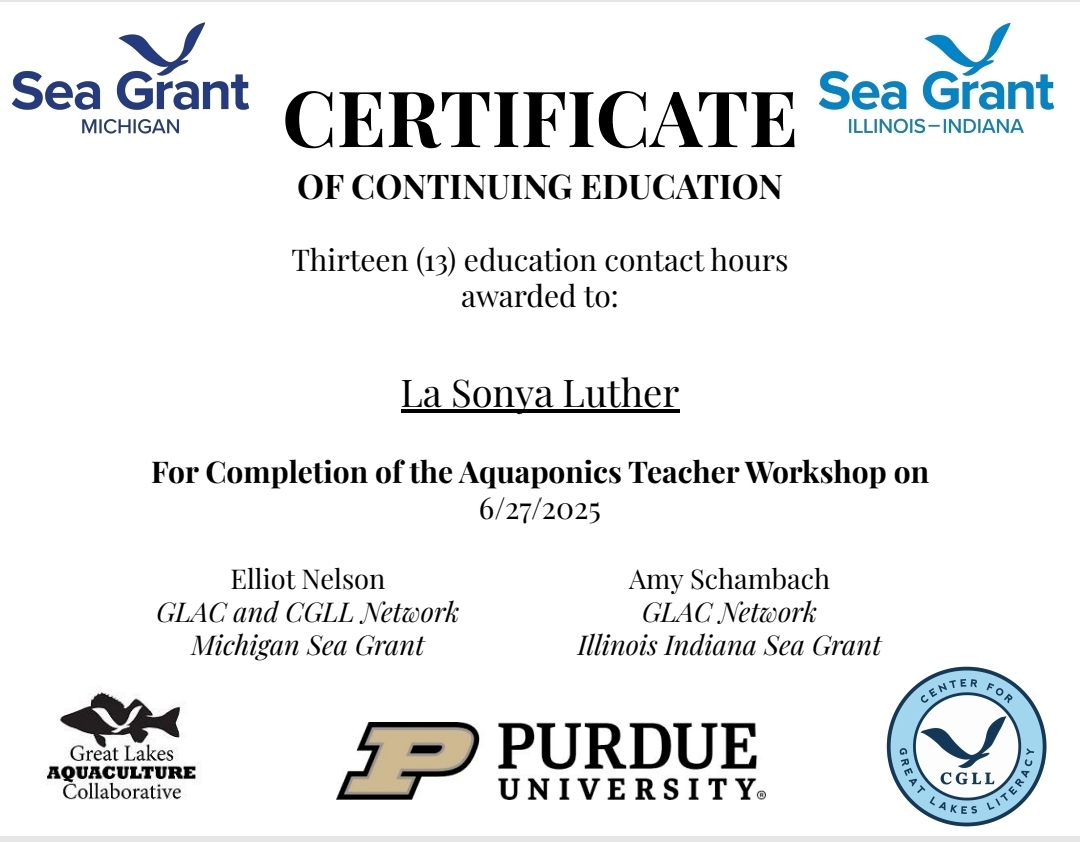
The project lead participated in a multi-day Aquaculture Teacher Training (June 26–27, 2025) that included hands-on instruction in aquaculture systems, water chemistry, nitrogen cycling, pest management, system troubleshooting, and small-scale system design. Knowledge gained was used to strengthen curriculum content under development, particularly related to water quality literacy and sustainable aquaculture systems.
A pilot mentoring experience was conducted with **one youth participant and her parent (mother–daughter team) from an Omaha community. Neither participant had prior aquaculture experience. Education included hands-on exposure to aquaculture concepts such as water chemistry, nitrogen cycling, system observation, and problem-solving, as well as place-based storytelling using biomimicry models (Pacific sockeye salmon and loggerhead sea turtle) to explain watershed flow, system resilience, and downstream water impacts.
As part of educator preparation, the project lead completed additional professional development and site-based learning at an indoor shrimp aquaculture facility, reinforcing technical capacity as a mentor. Following this engagement, the project lead was invited to participate with students in the Michigan Sea Grant Aquaculture Challenge, which will serve as a future pathway for broader youth engagement once curriculum testing is complete. Both of them received certificates from the program.
Outreach to youth remains in progress, with relationship- and trust-building emphasized due to community barriers.Curriculum has not yet been delivered to a group setting and is being refined prior to wider implementation.Following educator training, additional field-based learning was completed during the Colorado field study (May 24–June 2, 2026). The project included a guided tour of Roaring Judy Hatchery, where Kokanee Salmon production and Rainbow Trout operations were observed. Educational displays and discussions also introduced Cutthroat Trout conservation. A self-guided visit to Bellvue-Watson Hatchery provided additional observation of Rainbow Trout production systems. Historical learning about the Bonneville Cutthroat Trout and the Great Salt Lake informed the project's headwaters and watershed literacy framework, although this was learned through research and history rather than direct field observation in Utah.
Knowledge gained from these experiences was incorporated into the development of the Living Waters Stewardship Operating System, including watershed mapping activities, the Mentor Species Library, and educational materials connecting the Pacific Sockeye Salmon, Chinook Salmon, Kokanee Salmon, Loggerhead Sea Turtle, Southern Resident Orca, Rainbow Trout, Cutthroat Trout, Lake Sturgeon, Hickorynut Mussel, Freshwater Mussels, Quail, and other living examples to watershed stewardship, water quality, and aquaculture education.
We did have success with presenting to Rosebud Lakota nation's spring harvest camp on June 11, in South Dakota. The presentation focused on relationships with water, for ages 11-17. We had twelve youth, and we led in mullin, bitter root, wild turnips, and more (including connections made on the Colorado trip). We interviewed some of the youth after about their experiences.
Roaring Judy — toured Kokanee Salmon and Rainbow Trout.
Cutthroat Trout in Colorado — learned about them but did not tour them because they were off limits.
Bonneville Cutthroat Trout — associated with your Great Salt Lake learning, not the Colorado hatchery.
Bellvue-Watson — self-guided observation of Rainbow Trout.
Lake Sturgeon and Hickorynut Mussel are added to the Mentor Species for the Midwest because they were part of your educational framework.
- Other
Learning Outcomes
Increased understanding of water quality and its relationship to aquaculture, fish health, and watershed stewardship.
Improved knowledge of the nitrogen cycle, biological filtration, and the importance of observation before intervention.
Greater awareness of the interconnected relationships between headwaters, rivers, wetlands, and oceans.
Increased understanding of migratory species including Pacific Sockeye Salmon, Kokanee Salmon, Rainbow Trout, Cutthroat Trout, Loggerhead Sea Turtles, Southern Resident Orcas, Lake Sturgeon, and freshwater mussels as indicators of ecosystem health.
Improved ability to observe living systems through the Purdue Three-Tank Water Quality model and watershed mapping activities.
Increased appreciation for stewardship, conservation, and agriculture and aquaculture career pathways.
Greater understanding that healthy food systems depend upon healthy water, healthy habitats, and responsible stewardship.
During this project, two youth participants engaged in place-based aquaculture and watershed education through educator-guided learning, field experiences, water quality investigations, storytelling, and mentor species activities. Neither participant began the project with significant aquaculture experience. Through participation in the Purdue University Three-Tank Water Quality activities, discussions of water chemistry, biological filtration, and watershed processes, both youth demonstrated increased understanding of how water quality influences fish health and the movement of nutrients through living systems.
Field investigations and educator training were incorporated into the development of the Living Waters Stewardship Operating System (LWSOS), allowing participants to connect technical aquaculture concepts with broader watershed stewardship. Rather than viewing species independently, participants learned to recognize ecological relationships between Pacific Sockeye Salmon, Kokanee Salmon, Rainbow Trout, Cutthroat Trout, Southern Resident Orcas, Loggerhead Sea Turtles, Lake Sturgeon, freshwater mussels, and other mentor species as indicators of ecosystem function.
Participants also explored watershed mapping, observation skills, and the Three-Tank Water Quality Witness as tools for understanding how conditions at the headwaters influence downstream ecosystems. Storytelling, biological observation, and field experiences encouraged curiosity and systems thinking while reinforcing the importance of careful stewardship before intervention.
A significant outcome of the project was the development of the Living Waters Stewardship Operating System as an educational framework integrating aquaculture, watershed literacy, mentor species, and place-based learning. Although broader implementation will occur in future programming, this project established the educational foundation, strengthened educator capacity, and produced instructional resources that can support future youth engagement in aquaculture, watershed stewardship, and agriculture-related career exploration.
The project utilized a combination of existing aquaculture education resources, field-based learning experiences, and educational materials developed during the project. Primary instructional resources included the Michigan Sea Grant Aquaculture Educator Workshop curriculum, which incorporated the Purdue University Water Quality curriculum, including water chemistry, dissolved oxygen, ammonia, nitrogen cycling, biological filtration, and the Three-Tank Water Quality model.
Additional educational resources included hatchery learning at Roaring Judy Hatchery (Kokanee Salmon and Rainbow Trout production, with educational information about Cutthroat Trout), self-guided observation at Bellvue-Watson Hatchery (Rainbow Trout production), and watershed learning informed by the history and ecology of the Great Salt Lake and the Bonneville Cutthroat Trout.
Throughout the project, these resources were integrated into the development of the Living Waters Stewardship Operating System (LWSOS) and La'SOuL's Living Waters Formation, which served as the project's educational framework. Components developed included the Mentor Species Library, watershed mapping activities, the Three-Tank Water Quality Witness, Headwaters-to-Ocean learning pathway, George Washington Carver observation method, Carry-the-Current journal activities, and inquiry-based lessons using Pacific Sockeye Salmon, Chinook Salmon, Kokanee Salmon, Loggerhead Sea Turtle, Southern Resident Orca, Lake Sturgeon, Hickorynut Mussel, Rainbow Trout, Quail, and other mentor species to teach aquaculture, water quality, and watershed stewardship.
These materials were developed as pilot educational resources for future youth programming and continued refinement.
The greatest strength of these educational materials is their integration of aquaculture, watershed stewardship, biology, agriculture, and storytelling into a single place-based learning experience. Rather than teaching water quality, fish biology, or conservation as separate subjects, the Living Waters Stewardship Operating System connects them through observation, inquiry, and real-world examples. The curriculum encourages youth to investigate living systems, ask questions, collect evidence, and understand how local stewardship decisions influence downstream communities and ecosystems.
Another strength is the use of mentor species, watershed mapping, field experiences, and the Purdue Three-Tank Water Quality model to make scientific concepts visible and understandable. The materials are adaptable for homeschool settings, community organizations, after-school programs, camps, and informal education, and can be expanded or simplified for different age groups.
The primary weakness is that the curriculum is still in the pilot development stage. While the educational framework was developed through educator training, field investigations, and limited participant testing, broader classroom implementation and evaluation have not yet occurred. Additional field testing with larger youth groups will strengthen lesson sequencing, pacing, assessment tools, and age-specific adaptations.
Future development will continue refining lessons, mentor species investigations, watershed mapping activities, and hands-on aquaculture demonstrations while maintaining the project's emphasis on observation, stewardship, water quality, and local food systems. The project established a strong educational foundation that can continue to grow through future partnerships, educator feedback, and additional youth participation.
Project Outcomes
The project strengthened relationships with organizations supporting aquaculture and watershed education through educator training, field experiences, and community engagement. Knowledge gained through the Michigan Sea Grant Aquaculture Educator Workshop, Purdue water quality training, Colorado field study, and the Lakota Spring Harvest Camp increased the capacity to continue developing youth aquaculture and watershed education through the Living Waters Stewardship Operating System. These experiences established a stronger foundation for future educational partnerships and outreach.
The project leader continued developing and applying small-scale aquaculture and watershed stewardship practices, including water quality observation, nutrient cycling, mentor species education, watershed mapping, and integrated food production concepts. Personal experience raising quail for eggs and meat, along with field-based learning, informed the continued development of educational demonstrations emphasizing water quality, biological filtration, nutrient stewardship, and responsible management of living systems. These practices were incorporated into the Living Waters Stewardship Operating System for future educational use.
One of the most meaningful outcomes of this project involved a mother and daughter who participated in the Purdue University water quality workshop. Neither participant had previous aquaculture experience. Through hands-on water quality investigations, the Three-Tank Water Quality model, and discussions about watershed stewardship, both participants successfully completed the workshop and earned certificates.
The experience reinforced that aquaculture education can successfully combine scientific investigation with observation, storytelling, and stewardship. Rather than simply learning technical information, the participants explored how water quality, fish health, biological filtration, and watershed relationships are connected from local streams to larger ecosystems. Their participation also demonstrated that parents and youth can learn together, strengthening confidence and encouraging continued interest in aquaculture and natural resource stewardship.
An unexpected outcome of the project was the development of the Living Waters Stewardship Operating System (LWSOS). What began as curriculum development grew into a broader educational framework integrating aquaculture, watershed literacy, mentor species, water quality, field investigations, and place-based learning. This framework was strengthened through educator training, Colorado field experiences, and later shared with youth during the Lakota Spring Harvest Camp.
The project demonstrated that meaningful learning does not require a large number of participants. Working closely with a small group allowed educational activities to be refined while building a foundation for future youth programming and broader community engagement.
This project demonstrated the value of allowing beginning educators time to build knowledge, partnerships, and educational resources before measuring success primarily by participant numbers. Professional development, field investigations, and relationship-building created a stronger foundation for future youth programming than would have been possible without this preparation period.
I encourage SARE to continue supporting projects that combine educator capacity building with youth engagement, especially those serving rural, underserved, and community-based audiences. Field experiences, partnerships with hatcheries, universities, Tribal communities, and local organizations provide valuable learning opportunities that cannot be replicated through classroom instruction alone.
I also recommend continued support for interdisciplinary projects that connect agriculture, aquaculture, water quality, conservation, and local food systems through place-based learning. Integrating storytelling, observation, and hands-on investigation helps youth understand not only how food is produced, but also the importance of healthy watersheds, biological relationships, and responsible stewardship.
I appreciate the flexibility provided throughout this project and the encouragement from SARE staff as the project evolved from educator training into the development of the Living Waters Stewardship Operating System. The experience strengthened my ability to continue developing educational opportunities that connect aquaculture, watershed stewardship, and community resilience for future youth and families.