Final report for FW25-022
Project Information
There is an increasing interest in sustainable, small scale, diversified food production in our region and a strong desire for fresh, local produce. Forestdale Farm has seen an increasing demand for local produce from our community and local restaurants over the years. Despite this demand, there remain few farms and producers in our region. Land is limited and expensive with much of the area consisting of rocky and clay soils. Because the land is not historically agricultural land, often the soil conditions are poor, requiring a lot of labor and inputs to make it suitable for crop production. This can be cost prohibitive for new or marginalized growers. Furthermore, water resources are becoming increasingly scarce. Wells are very expensive in these areas and many growers utilize small ponds or other water catchment for irrigation purposes. We established a sustainable aquaculture system in one of our ponds and compared this to another catchment system without aquaculture. We irigated identical fields from each treatment and looked at how aquaculture can improve crop yields and soil health. In addition, fish production can serve as another commodity for small farms increasing profits while lowering costly inputs like organic fertilizers. By pairing small scale aquaculture with agriculture, we provided a much-needed example of how small farmers can overcome obstacles in regions like ours and provide sustainable, healthy produce for communities. Our results were shared with the community, schools, and producers through organized farm tours, workshops, and educational pamphlets.
We established a sustainable aquaculture system in a small irrigation catchment pond and compared this to conventional watering from catchment tanks without aquaculture. We planted and irrigated identical study areas on the farm for each treatment to look at how aquaculture can improve crop yields and soil health. In addition, we showed how fish production can serve as another commodity for small farms, increasing profits while lowering costly inputs like organic fertilizers. Our results were shared with the community, schools, and producers through organized farm tours, workshops, and educational pamphlets.
See attached Gantt Chart: Forestdale Farm Gantt_Chart1 SARE 2024
Cooperators
- - Technical Advisor
Research
Our project consisted of two treatments, an aquaculture treatment (a 16,000-gallon, EPDM lined, catchment pond stocked with channel catfish), and a standard treatment (a combined 16,000 gallons of catchment tanks without fish). Catfish were added to the aquaculture treatment only. The aquaculture treatment had a small magnetic drive pump (Danner mag drive 18) to circulate water and help with biological filtration. An oxygen diffuser (aeration pump) was added to supply extra dissolved oxygen critical for treatments containing fish and served as the primary oxygen source. A backup oxygen source was placed in each treatment tank (Aquascape pro air 60) for when sun levels are too low for the solar water aerator. These components served to transition the catchment pond into a system which was suitable for rearing fish. Each treatment had its own independent irrigation system consisting of pump, filters, and drip irrigation for irrigating crops (Rain-Flo Irrigation LLC).
The aquaculture treatment was stocked with juvenile catfish produced from brood stock from Browns Fish Farm. A subsample of fish was measured at the start of the experiment and at the end to get a growth estimate for fish over the entire experiment. Fish were fed ad-libitum daily with a standard hatchery ration of organic fish feed (Aquamax 200 pellet feed). Water temperature in each system was recorded to compare temperatures for fish growth. We also took nitrate, nitrite and ammonia water samples as needed, to determine water quality and the available nutrient load in the water and insure productivity of the aquaculture system. A solar pond cover was built over the pond with fish to prevent evaporation, limit loss of fish to predation by birds, and to increase water temperature to improve fish growth.
Water treatments were applied across 6 identical raised beds, three for aquaculture treatments and three for standard treatments. All treatments took place at Forestdale Farm in Flagstaff, Arizona. Each bed was 4 feet wide by 40 feet long (160 square feet) and was planted with either kale, arugula, or lettuce—all raised beds were seeded at the same ratio. The beds were prepared identically at the beginning of the season, amended with applications of aged compost, and tilthed prior to planting. A complete soil sample (Ward laboratory) was taken from each bed before planting. Soil samples looked at pH, soluble salts, excess lime, organic matter (%LOI), soil respiration, total nitrogen, organic nitrogen, total organic carbon, ammonium, nitrate, microbially active carbon, organic C to organic N, Organic N release, organic N reserve, phosphorus, potassium, zinc, iron, manganese, copper, sulfate, calcium, magnesium, and sodium. We also looked at the biotilth and soil biology including fungi, bacteria, actinobacteria, protozoa, bacterial feeding nematodes, fungal-feeding nematodes, predatory nematodes, oomycetes, anaerobic ciliates, root-feeding nematodes. Another soil sample was taken at the end of the experiment. These samples were analyzed for variance between the start and finish of the experiment.
Watering frequency was the same for each treatment but varied depending on the time of year. Crops were harvested when determined ready (dependent on weather). Every bed was harvested with a quick cut harvester at a standardized height just above the first set of true leaves. The weight and quality of the harvests from each treatment was individually recorded. After the final harvest we took another set of soil samples from each bed to be compared with previous samples taken.
At the end of the project, we analyzed all the data and compared the overall yields and soil conditions of each treatment. We looked at fish growth and condition data for channel catfish. Fish growth was used to look at the marketability of catfish as an additional commodity for the farm. Mean yields (by weight) was evaluated across treatments using two-sample t-tests (JMP 14 Statistics).
Our results looked at crop yields across treatments, soil conditions, and growth of catfish. Although there was no statistical significance in the data due to the short duration of the project we did see very strong patterns in our research. With crop yields we saw an increase in yields in all the treatments that were irrigated from water containing fish. Salad green and baby green production was consistently higher for each variety (Arugula, Kale, and lettuce) when watered from tanks containing fish. The increase in production is not statistically significant (at a 95%) level, but the pattern of higher production is evident. This experiment needs to be repeated with higher replication to definitively say that production is higher, but these data are suggestive of an effect, and this effect is consistent with what we would expect (higher production utilizing water with higher nutrient content). Even when salad greens varieties are combined the results are still not statistically significant (at a 95% level), but the pattern of higher production with water containing fish is evident. Large variability in the pounds of salad greens produced in both treatments created a situation where getting a result that is statistically significant would require additional replication. The pattern of higher production in the treatment group utilizing water with fish is evident but not statistically significant with the current level of replication. In addition, we observed improved quality of crops in the aquaculture system, especially with multiple cuts to the crops. Crops irrigated from water with catfish recovered quicker from the first harvest and were more robust and healthier for subsequent harvests. This is important for many of the cut and come again crops used in baby green and salad production. Leafy greens graphs 2025 SARE
For soil conditions the trail period was too short to see significant changes in nutrients in the soil. The soil is a complex system and a longer period, and more tests would be needed to determine changes. It is likely that because the additional nutrients (primarily nitrate) from the treatments with fish, were suspended in the irrigation water, that these nutrients were easily available for plants to uptake so it expected it would take longer to see impacts on the soil. Soil Results PFLA 10-10-2025 Soil Results. PLFA-07-28-2025 Soil Results. SHA. 07-28-2025 Soil-Results-SHA. 10-10-2025
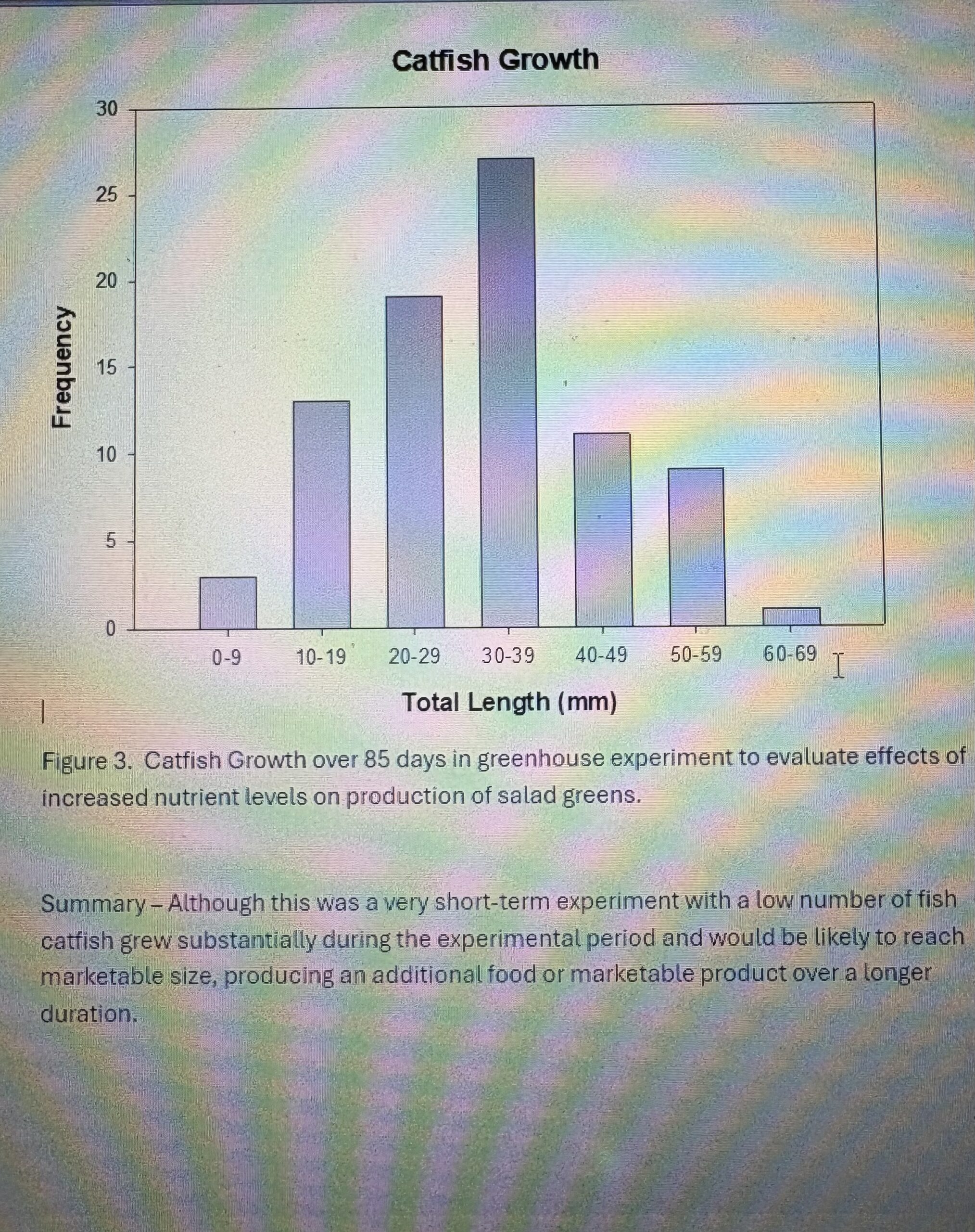
Catfish grew substantially during the experimental period and would be likely to reach marketable size, producing an additional food or marketable product over longer duration.
Research outcomes
These data are suggestive that farmers may be able to increase yield of salad greens by utilizing water from ponds or tanks containing fish. This is a very important outcome as it suggests an increase in production for small farms who utilize aquaculture systems on their farms. This alone would be enough to warrant the use of aquaculture, because with increased yields you have more income per square foot. This can be a huge finical incentive for small famers. For farmers who use cut and come again crops such as salad mixes and baby greens, we saw improved crop quality, as well as yields, on subsequent harvests. Crops recovered quicker and were more robust making these harvests more productive in the treatments irrigated from water containing fish. This creates a more marketable crop and a higher quality suitable for higher end markets.
Although there was not a significant change in nutrients across the treatments it is expected that with time the excess nutrients would build up in the soil making the beds more productive. However, it seems that the main benefits of irrigating with water from aquaculture systems is in the immediate nutrients that become available for plants to take up. In the treatments with fish, nutrients are suspended in the water column and so are immediately available for the plants to take up. This leads to increased growth in the plants and healthy plants. It also would suggest that the plants would not need to take as much reserve nutrients from the soil, so over time the soil health would increase. This is especially true related to nitrogen. Since leafy greens utilize a lot of nitrogen for growth, by constantly adding nitrogen while irrigating throughout the season there would be less depletion of nitrogen is the soil. Also, because many nutrients can be tied up in the soil, in carbon or by other means, the constant supply of nutrients from fish water would allow plants to thrive across a variety of soil conditions. .
We saw significant fish growth even over the relativity short period of the project. This suggests that with proper management farmers can produce another commodity to sell increasing farm revenue. In addition, the solar cover on the pond was very important for this growth since catfish are warm water species and thrive and grow faster in warmer water. In cooler climates increasing the water temperature can shorten the time needed to rear fish to marketable sizes.
Education and Outreach
Participation summary:
We developed a variety of outreach goals focused on making our project and results known to the general public, schools and universities, and growers in our region. For the general public we held tours twice a year, produced fliers for distribution, and shared information with our community. The goal for this component was to spread awareness of the project and focus on sustainable and ecological growing and fish production. The farm tours involved an up-close look at the systems and discussion of the project, focusing on the benefits of aquaculture growing in our region. They helped inspire the community and encourage growers to grow their own food. All farm tours were held at Forestdale Farm so participants could experience the project firsthand. The first farm tour was held September 20th and detailed the project at its current state. The second farm tour was September 25th and looked at the project in more depth including expected results. Flyers of the project were designed and printed and included descriptions and pictures of the project and its relevance to sustainable agriculture and conservation. Forestdale Farm will display the fliers at their booth at the Flagstaff Community Market, at the farm share produce pickups, the farmstand, and at seasonal events such as seedling sales and harvest festivals. For the next outreach goal, we developed a short video that highlights all aspects of the project. This served as a way to document the project in depth so we can share on our website and across social media platforms. It will also serve as an informative video for producers who would like to adopt similar practices on their farm. To reach schools and university populations, we worked with Northern Arizona University’s Sustainability programs and permaculture designs courses, to highlight parts of our experiment relevant to the fields being studied. For the last component, workshop for producers, we reached out to other producers and interested commercial growers in our region to come to the farm for discussion of the project. We had Northern Ariona's Growers Coalition out to the farm to look at the system in depth and discuss the benefits associated with the project. We also reached out to farms at the local farmers markets, farmers on the nearby Hopi and Navajo reservations, and other small producers in our region. With these groups we looked at set up and design, detailing all aspects of getting started including equipment. We examined the maintenance of systems, looking at daily operation and troubleshooting of specific problems found in aquaculture. Participants were introduced to fish production, keeping healthy fish, and the benefits of fish production for crop yields and soil health. All relevant information we learned from the project was shared with producers. This workshop took place at Forestdale Farm. It was held on October 6th. At the end of the project, we put together a reference page detailing our seasonal yields, fish growth and condition, and lessons learned. All the information from the project will be available to anyone interested and shared on our website and across social media platforms, and our farm email lists.
We focused on making our project and results known to the general public, schools and universities, and growers in our region. Tours were held twice a year for the general public. At the tours we had everyone who participated fill out the "Western Region Sustainable Agriculture Research and Education Program Outreach Survey" and had discussions after the project. We recorded all these results and took notes of what people gained from each tour. This helped spread awareness of the project and provided an up-close look at the systems and discussion of the project, focusing on the benefits of aquaculture growing in our region. We found that many people gained new knowledge from these tours and had positive responses with all participants. For the next outreach goal, we developed a short video that highlights all aspects of the project. This served as a way to document the project so we can share on our website and across social media platforms. This was a great way to document the project at its current stage and make information available to the public. To reach schools and university populations, we worked with Northern Arizona University’s Sustainability programs and permaculture designs courses, to highlight parts of our experiment relevant to the fields being studied. We had everyone who participated fill out the "Western Region Sustainable Agriculture Research and Education Program Outreach Survey." All responses were positive and there was an increase in knowledge across all participants. For the last component, workshop for producers, we reached out to other producers and interested commercial growers in our region to come to the farm for discussion of the project. We had Northern Ariona's Growers Coalition out to the farm to look at the system in depth and discuss the benefits associated with the project. Everyone who participated filled out the "Western Region Sustainable Agriculture Research and Education Program Outreach Survey." These results showed lots of enthusiasm for the project and people responded that they were interested in learning more and perhaps adapting certain parts into current growing operations. We had several people ask about best ways to set up and how to start on a small scale. We put together a reference page detailing the project. This was a very useful tool for general information about the project.
Education and Outreach Outcomes
For the general public we held tours twice a year, produced fliers for distribution, and shared information with our community. The farm tours seemed to be the most positive experience for the general public. Many participants were not aware of how these systems work and were very interested an excited about the project. These tours helped inspire the community and many expressed a new desire to grow their own food at home. The first farm tour was held September 20th and the second tour was September 25th. Flyers of the project were designed and printed and although this was hard to determine the interest and effectiveness of, it did create an easy way to reach a broader audience. In addition, these documents will be useful for the future as we can continue to share them with anyone who is interested or those who ask about the project. For the next outreach goal, we developed a short video that highlights all aspects of the project. This was another great way to document the project and reach a larger audience. However, we did have some difficulties filming and editing. It would be beneficial to have a professional videographer for future filming would make the quality better for sharing with larger audiences. Northern Arizona University’s Sustainability programs and permaculture designs courses were very interested in the project and having them out to the farm to learn was very impactful. For the last component, workshop for producers, we reached out to other producers and interested commercial growers in our region to come to the farm for discussion of the project. This seemed to be the largest educational benefit of this project and many growers were very interested and had lots of questions about the project. The Northern Ariona's Growers Coalition was a great group and many expressed interests in utilizing similar ideas to improve yields.
Increasing crop yields
Soil quality and potential impacts on soil
Aquaculture design and implementation
Information Products
- Video. Increasing revenue and sustainable practices on farms: Improving crop yield, soil health, and diversity by combining aquaculture with intensive vegetable production.
- Informational Document. Increasing revenue and sustainable practices on farms: Improving crop yield, soil health, and diversity by combining aquaculture with intensive vegetable production.