Final report for ONE24-455
Project Information
This project included the design, build, and testing of an improved applicator for urine-derived fertilizer to row field crops. The fertilizer applicator was built with a ground-driven roller pump to achieve a higher rate of fertilizer dispensing than in previously built gravity-fed and pumped systems. The pump system was tested at a partner-farm, Pete’s Stand, in the summer of 2025. It was used to apply a concentrated urine-derived fertilizer to sweet corn grown in three treatment groups: 1) a non-fertilized control; 2) a treatment receiving urine fertilization one pass of the applicator (~40lbs N/acre); and 3) a treatment receiving urine fertilization from two passes of the applicator (~80lbs N/acre). The applicator operations were found to be effective; the tractor pulling the applicator was able to both cultivate and fertilize two corn rows per pass while driving at 6mph; there was little indication of ammonia volatilization from fertilizer after application; and a leaf tissue analysis indicated adequate nutrient uptake by fertilized crops. A qualitative assessment of the applicator performance indicated high partner-farmer satisfaction in the applicator’s ease of operations and effectiveness. The design and testing of the applicator were documented in a 15 minute video, which was screened at 2 outreach events and published to youtube.
This project evaluated the ease of use, effectiveness, and consistency of a customized fertilizer applicator using a ground-driven "roller pump" for applying a sanitized, concentrated urine-derived fertilizer to sweet corn. We purchased a multi-tube roller pump and the necessary auxiliary component parts to assemble a complete system that can: 1) consistently deliver the desired amount of urine fertilizer per acre (adjustable by the farmer); 2) cover the urine fertilizer with soil immediately upon application to prevent ammonia loss; and 3) be easy to operate and maintain. Furthermore, we tested the practical limits of the system’s dosing rates and worked to discover any mechanical weaknesses. The urine-fertilized crops were monitored for signs of healthy development (visually and through tissue analysis), and any differences in health and performance from synthetically-fertilized crops. Interviews with the partner-farmer documented his qualitative observations of crop performance. This assessment aimed to determine the potential for this applicator to be used for other crops and application contexts. Desired outcomes of the roller pump system testing included:
The system delivered a consistent and correct urine fertilizer volume per acre, such that:
- There was no variation in the quantity of fertilizer dispensed over a set distance when the tractor drove at different speeds.
- The drive wheel consistently powered the pump as the tractor moved over the ground, even when encountering bumps, divots, etc.
- The pump provided a practical flow rate for urine concentrate and delivered urine at the correct depth and location relative to row crops.
- There were no differences in plant development and overall health during the growing season between plants receiving urine fertilizer or synthetic fertilizer.
Ammonia volatilization limited during application, so that:
- The urine fertilizer was immediately buried in soil upon application to the ground.
- Little to no ammonia odor was present following application.
The roller pump system was easy to operate and maintain, and contexts for its potential use understood:
- The farmer-partner reported an easy-to-operate user experience with minimal challenges.
- There were no mechanical failures or signs of wear/weakness in any system components.
- The system was expected to be useful for other crops and application contexts besides sweet corn.
- The system limits were understood through a determination of the maximum and minimum practical dosing rates possible.
Diverting human urine from the waste stream and reclaiming it as a fertilizer can simultaneously address issues of: 1) dependence of agriculture on unsustainable and expensive sources of fertilizer; and 2) pollution of sensitive waterways from excess nutrients. Synthetic nitrogen fertilizer is derived from the Haber-Bosh process, which accounts for 1.2% of global energy use and associated greenhouse gas emissions (Dawson & Hilton 2011), while high-N amendments are expensive and supplies are uncertain (Jones & Nti 2022). Phosphate is a finite resource, subject to politically induced price swings, and the Global Phosphorous Research Initiative is predicting a shortage of high-quality rock phosphate within 40 years.
In addition to concerns around the sustainability of their supply, nitrogen and phosphorus are also a subject of focus for their negative affect on water quality. Surface waters throughout the Northeast are heavily impacted by nitrogen and phosphorus pollution from both agricultural runoff as well as wastewater effluent. 70% of the nitrogen and 50% of the phosphorus in wastewater effluent is from human urine, and many wastewater plants and septic systems are unable to control this nutrient pollution and are poorly suited to nutrient reclamation.
By addressing both issues of fertilizer scarcity and nutrient pollution, this project advances methods for the application of urine fertilizer in alignment with a circular nutrient economy. The responsible flow of nutrients through a circular nutrient economy honors the holistic connection among land, water, air, and all living beings described in the Northeast SARE’s outcome statement, as it is underpinned by the understanding that Earth’s systems are linked through interdependent exchanges of nutrients. A circular nutrient economy also advances the vision of an accessible, sustainable, and just agricultural system, as it has the potential to provide farmers with a responsibly-sourced, financially accessible, and dependable fertilizer supply. Developing local and affordable sources of fertilizer could help alleviate financial barriers which disproportionately affect farmers of marginalized backgrounds while reducing nutrient loading in communities lacking resources to address polluted waterways.
The potential to reclaim urine-derived fertilizer within a circular nutrient economy is immense. With 54.5 million people living in the Northeast SARE region, each producing 4 kg of nitrogen in their urine annually (Vinnerås & Jönsson, 2002), there is a maximum potential to source 218 million kg of nitrogen fertilizer each year, (plus P, K and trace nutrients,) which would meet the majority of the region’s approximately 280 million kg demand for N fertilizer (US EPA, 2019). While nitrogen is the most significant nutrient that human urine could supply, Rich Earth has also successfully separated phosphorus from urine, producing two products: struvite, and a low-P liquid fertilizer.
Although still uncommon, urine diversion is gaining traction. Laufen, a high-end porcelain company, is manufacturing a new urine-diverting toilet, and Rich Earth Institute’s spin-off (Brightwater Tools) is now selling urine pasteurizers that will enable farms throughout Vermont to produce state-permitted urine fertilizer. Charcoal filtration can remove pharmaceutical contaminants in urine (Solanki & Boyer, 2017), thereby addressing concerns of some farmers and stakeholders identified in prior research, though research indicates that pharmaceutical uptake by plans from urine fertilizer is negligible (Rodriguez et. al., 2025). The practice of urine collection is increasing in the Northeast, with the establishment of the urine-collecting portable toilet company, called Wasted*, in Burlington, VT, and a municipal initiative in Falmouth, MA, aimed at reducing nitrogen emissions to coastal waters. Urine-derived fertilizers are now certified for sale in several states including Vermont, Massachusetts, and Michigan. In an important development, urine-derived fertilizers have also now been preliminarily listed by the Association of American Plant Food Control Officials (AAPFCO) as a defined fertilizer type, facilitating and simplifying certification in additional states.
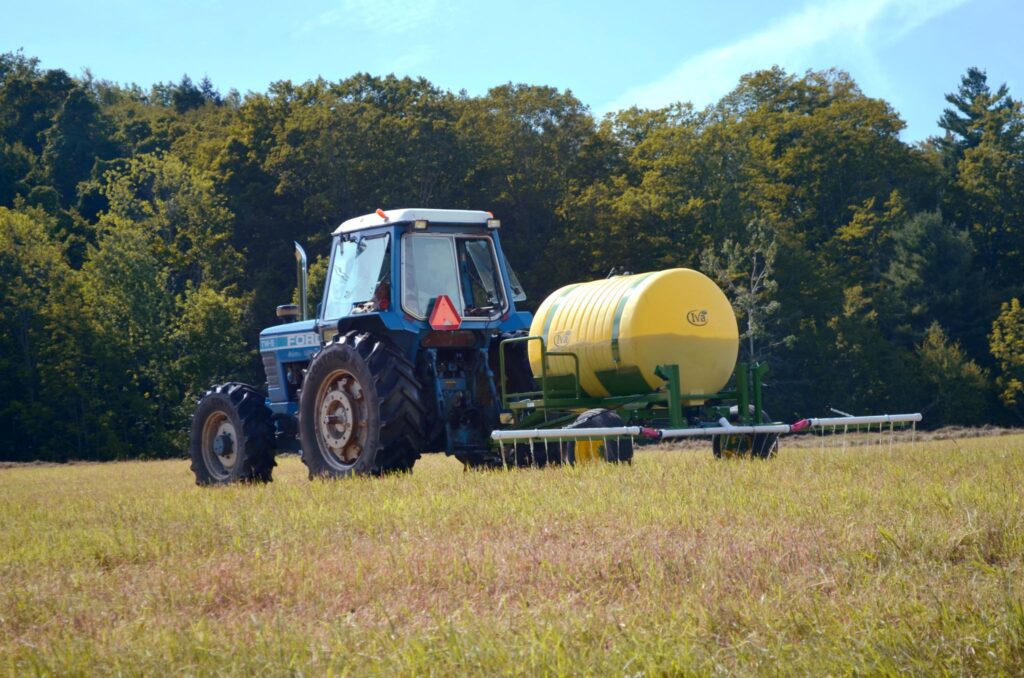
With increasing access to urine fertilizer, farmers will need applicator systems tailored to urine fertilization. The Rich Earth Institute has previously demonstrated the effectiveness of a boomed hay applicator designed to apply urine in multiple gentle streams to hayfields (Figure 1). While this system is adequate for hay fertilization, it does not easily allow for precise or consistent application rates, and achieving a high per-acre application rate requires many trips to and from the field to refill the tank.
Pre-concentration of the urine fertilizer can increase the labor and fuel efficiency of the fertilization process, which Rich Earth has previously demonstrated by applying concentrated urine fertilizer to sweet corn (Noe-Hays et al., 2024). The use of urine concentrate reduced the number of tank refills and increased the land area fertilized per tank of urine. U-Grow Concentrate, a concentrated urine fertilizer product, is made at the Rich Earth Institute’s Research Center using freeze-thaw technology developed and operated by Brightwater Tools. The roller pump applicator system designed in this project was used to apply U-Grow Concentrate to achieve the desired dosing rate using methods practical for farm-scale, and to allow for a comparison of process and crop results to conventional fertilization practices.
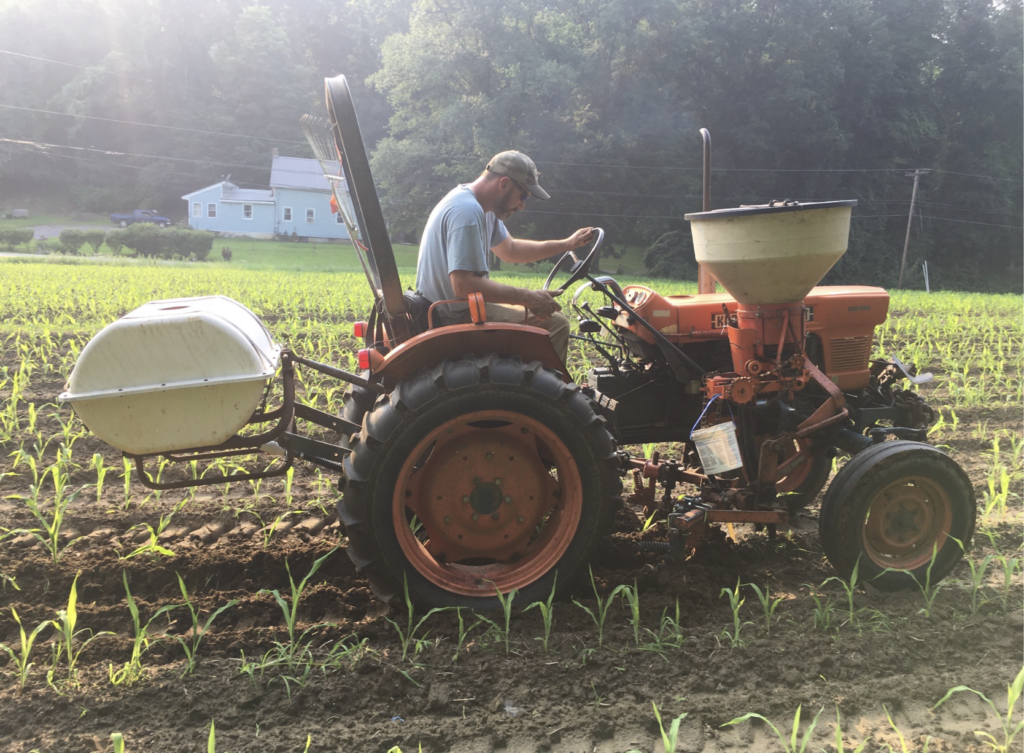
The use of concentrated urine fertilizer increases the importance of controlling ammonia loss through volatilization, because urine concentrate is more prone to ammonia volatilization than non-concentrated urine. Volatilization from urine fertilizer has been shown to be reduced by applying urine in a gentle stream close to the soil, or, better yet, by incorporating the urine beneath the soil surface (Noe-Hays, 2018). Rich Earth’s previously-tested prototype row applicator (Figure 2) reduced ammonia volatilization from concentrated urine fertilizer by covering the applied urine with soil using a cultivator tine immediately after application (Noe-Hays et al., 2024).
To address the need for refined equipment for the application of urine-derived fertilizer at farm scale, this study developed an applicator with: 1) consistent dosing; 2) minimal ammonia volatilization; and 3) efficiency and ease of operation. To achieve a controlled dosing of urine fertilizer, we used a "roller pump”, also known as a peristaltic pump. Roller pumps are popular because of their low cost, compact size, and easy maintenance. They can be driven by a wheel that contacts the ground, which mechanically links the fertilizer flow rate to the tractor ground speed such that a steady fertilizer volume per acre rate is achieved regardless of tractor speed. To limit ammonia losses, a cultivator tine covers urine with soil immediately after application in the same fashion as our prototype row applicator. To achieve a performance comparable to typical fertilizer equipment, the roller pump system fertilizes multiple rows at once, applying urine to an optimal depth and distance relative to crop rows. These features are intended to refine the process of applying urine fertilizer and increase farm productivity for farmers interested in adopting urine fertilization practices.
Sources Cited
Dawson, C. J., & Hilton, J. (2011). Fertiliser availability in a resource-limited world: Production and recycling of nitrogen and phosphorus. Food Policy, 36, S14–S22. https://doi.org/10.1016/j.foodpol.2010.11.012
Jones, K., & Nti, F. (2022). Impacts and Repercussions of Price Increases on the Global Fertilizer Market. Foreign Agricultural Service U.S. Department of Agriculture. https://fas.usda.gov/sites/default/files/2022-09/IATR%20Fertlizer%20Final.pdf
Noe-Hays, A. (2018). Practical Strategies for Reducing Ammonia Volatilization from Urine-Derived Fertilizers (SARE ONE18-318). https://projects.sare.org/project-reports/one18-318/
Noe-Hays, A., Schreiber, T., Cavicchi, J., Saveson, G., & Davis, A. (2024). Farm-scale Urine Fertilizer Implementation: Refining Application Methods, Gathering Buyer and Consumer Perspectives, and Producing Farmer Guide (SARE ONE22-426). https://projects.sare.org/?post_type=project_report&p=1072403
Rodriguez, E. E., Dickman, R., Kennedy, B., Aga, D., Noe-Hays, A., Wigginton, K. R., Jolliet, O., & Love, N. G. (2025). Comparative Exposure Assessment of Crops Grown by Urine-Derived Fertilizer and Crops Irrigated with Reclaimed Water. Environmental Science & Technology, 59(25), 13034–13041. https://doi.org/10.1021/acs.est.4c12633
Solanki, A., & Boyer, T. (2017). Pharmaceutical removal in synthetic human urine using biochar. Environmental Science: Water Research & Technology, 3(3), 553–565. https://doi.org/10.1039/C6EW00224B
US EPA. (2019, January 30). Commercial Fertilizer Purchased. https://www.epa.gov/nutrient-policy-data/commercial-fertilizer-purchased
Cooperators
- - Producer (Researcher)
- (Researcher)
- (Researcher)
- (Researcher)
- (Educator and Researcher)
Research
Applicator design
We worked with Pequea Planter LCC (based in Gap, PA) to design a custom fertilizer applicator for urine fertilizer. Pequea Planter was recommended to the Rich Earth Institute by Ray Rex of Four Rex Farm in Hadley, MA, who uses roller pumps to apply liquid fertilizer on his farm. Pequea Planter pumps are made with materials that have good corrosion resistance, which is an important quality when working with urine fertilizer. The custom pump we purchased cost just under $2,500 before shipping.
The applicator was made up from three components: (1) of a 275-gallon tank (standard IBC tote) held on the front forks of the tractor, connected by a hose to (2) an 18-tube roller pump powered by a ground-driven wheel (fabricated by Pequea Planter), which pumped urine fertilizer into (3) a manifold with drop hoses (fabricated by Rich Earth) that delivered fertilizer to the ground just in front of the cultivator tool.
Since our urine-derived fertilizers (both regular and concentrated urine fertilizer) are less concentrated than synthetic liquid fertilizers, we designed the applicator to apply a larger volume of fertilizer per row-foot that would be applied if a farmer were spreading concentrated synthetic fertilizer. The roller pump has 18 output tubes, each of which can be directed to a single crop row, resulting in a small volume of liquid being applied per row, but 18 rows being covered in one pass. Alternatively, the multiple pump output tubes can be combined into a smaller number of delivery hoses, resulting in the application of a larger volume of liquid per row, but covering fewer rows at a time. For the urine applicator, we made two manifolds, each receiving the combined flow of nine roller pump output tubes, with the output from each manifold being a single 1" diameter hose that directed urine to a single row. This resulted in two rows being fertilized per tractor pass (See photo 3 in the "Roller Pump Photos" under "information products")
The roller pump is driven by a shaft connected to a ground-driven wheel. Because Pequea Planter’s liquid fertilizer applicators are typically mounted to and driven off of corn planters, we worked with Pequea Planter to adapt the system so it attaches to the three-point hitch with the fertilizer pump’s drive wheel running directly off the ground.
Pequea Planter fabricated the multi-tube roller pump and the ground-drive wheel, and Rich Earth designed and fabricated the hosing, manifolds, and mounting hardware to combine the output of nine pump tubes to deliver the urine fertilizer to the correct location on the cultivator.
For use in the field, Janiszyn mounted the roller pump system onto a 2-row Lilliston rolling cultivator. U-Grow Concentrate was held in an IBC tote on the front forks of the tractor, and Janiszyn controlled the flow of urine from the tote to the pump using a hand-operated ball valve within an arms-reach of the tractor seat. The valve was opened at the start of the application to allow urine to flow from the IBC tote to the roller pump. Cultivator tines were positioned on the cultivator to immediately bury the urine concentrate as it was applied.
Qualitative Assessment Methods:
In previous SARE partnership projects, Rich Earth has found that conducting recorded conversations is an effective way to ensure that farmer observations are captured, while minimizing the time farmers need to spend on documentation. To that end, farmer-partner John Janiszyn was interviewed by Rich Earth social research director, Tatiana Schreiber on August 8th and December 4th 2026. (A late planting of corn was used for this experiment, so August was "mid-season"; the Dec 4th was post-harvest, later than planned for scheduling reasons.)
The first interview covered the following topics: initial use of the equipment (set-up, integration with existing equipment, and use in the field, including control of dosing and other issues); how Janiszyn might think of using the equipment in the future (other crops, etc.); suggestions for improvement of the equipment; the collaboration with Rich Earth, including initial involvement in planning, use of our "memo of understanding," estimate of time involved, and any other issues; and best timing for the tissue sampling and second interview.
The second interview addressed: observations of any differences among the treatments, including yield, pest pressure and anything else; comments on the tissue sample results; further reflections on how the application went; additional thoughts on potential uses of the equipment in the future and suggestions for improvement; further reflection on the collaboration with Rich Earth; and ideas for future research.
The interviews were recorded and the audio logged. An interim interview analysis was prepared, pulling out the key points and quotes for inclusion in this final report. That report was shared with the research team to integrate with the field trial results and draw from for our research conclusions.
System evaluation
The applicator system design and performance was assessed both qualitatively and quantitatively by Rich Earth Institute staff (Tatiana Schreiber, Arthur Davis, Gretchen Saveson, and Abraham Noe-Hays), and by farmer partner John Janiszyn.
Preliminary tests of the system to quantify application rates were conducted using water at Pete’s Stand in Walpole, NH, prior to field application. We collected the dosed water in bottles over a predetermined distance to determine the variation in the quantity of fertilizer dispensed and the maximum and minimum practical dosing rates achieved by combining multiple pump tubes. During this testing, we determined that the applicator dispensed about 2.4 gallons per 100 ft of distance traveled in tractor gear 5 (a relatively fast cultivation speed). This resulted in a maximum nitrogen application rate of about 40 lbs N/acre when using the highest gear ratio on the roller pump, 34" corn row spacing, application of fertilizer to two crop rows per pass, and a urine concentrate N-content of 26.2 g N/L.
A final evaluation of the system mechanics and effectiveness was conducted through field trials at John Janiszyn’s farm in Westminster, VT, on July 22, 2025. Sweet corn was fertilized by sidedressing according to four fertilizer treatments: 1) urine concentrate applied with two passes (urine double-pass) of the roller pump applicator (~80 lbs N/ acre), 2) urine concentrate applied with one pass (urine single-pass) of the roller pump applicator (~40 lbs N/ acre), 3) urea applied with conventional equipment (~80 lbs N/ acre), or 4) left unfertilized as a control. Treatments were applied to subplots consisting of two rows of corn ranging from 80’ to 250’ in length. The urine double-pass and urea treatments were replicated in 3 subplots each, while the urine single-pass and control were replicated in 2 subplots each, rather than in triplicate, to reduce potential harvest losses due to the lower application rates in those treatments. Treatment areas were not applied in a randomized design due to operational farm constraints.
Janiszyn had already applied manure to all of the trial field area at 15-20 tons per acre when he prepped the field for corn planting, followed by a 10-5-40 starter fertilizer at planting time.
At the time of field application, the following questions guided the pump system evaluation:
Qualitative questions:
- Did the drive wheel consistently power the pump as the tractor moves over the ground, even when encountering bumps, divots, etc?
- Did the urine fertilizer get immediately buried in soil upon application to the ground by the cultivator tines? Is there a noticeable ammonia odor following application?
- Were there any challenges from a user operations perspective? Is it easy to operate?
- Were there any mechanical failures or signs of wear/weakness in any components?
- Were there any visible differences in plant development and overall health during the growing season between plants receiving urine fertilizer or conventional fertilizer?
- Could this system be useful for other crop and application contexts besides sweet corn?
Quantitative questions:
- How much variation was there in the quantity of fertilizer dispensed over a set distance when the tractor is driving at different speeds?
- What were the maximum and minimum practical dosing rates we could achieve by combining multiple pump tubes and by changing the ratios of the sprockets that drive the pump system? (And do we encounter any practical limitations as we seek to maximize flow rate to each row? The manufacturer suggested that at the highest dosing rates, there could be issues with flow limitations in the pump manifolds at high drive speeds).
- Were there statistical differences in leaf tissue nutrient content between corn fertilized with urine concentrate, synthetic urine, and a non-fertilized control?
To assess the availability and uptake of nitrogen and other nutrients for each fertilizer treatment, one foliar sample was collected per treatment area on August 27, 2025 and analyzed by Spectrum Analytic Inc. t. ANOVA tests were performed to determine differences between treatments using R statistical software (R Core Team, 2025).
As noted above, for further qualitative assessment, Rich Earth staff conducted two site visits (one when the plants were in rapid growth stage; one at the end of the growing season), including conversation with Janiszyn concerning his experiences with the applicator, as well as his observations of plant growth and development over the course of the growing season. Rich Earth staff also performed photo and video documentation of the equipment, application process, and ongoing plant development. Excerpts from site visit conversations were used alongside photo and video documentation to create a video to make our results accessible to farmers and other relevant audiences.
Through both initial testing (using water) and field testing (using U-Grow Concentrate), we found the roller pump system to be an improvement over our previous prototype urine fertilizer applicator for corn. The previous system required Janiszyn to drive the tractor at slow, carefully-maintained speeds to achieve a consistent application rate from the fixed flow fertilizer applicator, and was only able to apply to one crop row at a time. In the present trials, the roller pump system allowed for application to two crop rows simultaneously while driving at faster speeds, with a flow rate that automatically adjusted for tractor speed by dispensing according to distance travelled.
Regarding our qualitative analysis, we observed the following:
Did the drive wheel consistently power the pump as the tractor moves over the ground, even when encountering bumps, divots, etc?
Yes, the spring held the drive wheel to the ground and we never observed the tractor moving forward without also turning the drive-wheel, which in turn ran the pump.
Did the urine fertilizer get immediately buried in soil upon application to the ground by the cultivator tines? Is there a noticeable ammonia odor following application?
Yes, the urine fertilizer was immediately buried and we did not observe any liquid on the surface once the tractor had passed, nor was there any noticeable ammonia smell present.
Were there any challenges from a user operations perspective? Is it easy to operate?
The pump and drive wheel assembly was heavy and had to be held in position to be attached to the cultivator. Once the pump and drive wheel assembly was attached and the fertilizer drop hose spacing was set correctly to match the row spacing, all Janiszyn had to do was pick up the IBC tank with the front forks and connect the infeed hose between the tank and the pump.
Farmer interviews indicated overall satisfaction with the ease-of-use and effectiveness of the application system. Janiszyn reported enthusiasm for the speed with which the fertilizer could be applied, commenting that, "I could do two rows, and I was going six mile an hour, that's pretty fast when you're cultivating, twice as fast as I was traveling with the other tractor… and the other tractor I was only doing one row, so I was getting four times the work done with this set- up and it wasn't speed dependent" He speculated that in the future, if he had 200 gallons of urine in the bulk tank on the front of his cultivator "I could do a whole field, several acres, without stopping… no matter what speed I'm going, it would give me the same rate… it's better, the faster you do it, you save time, you save money." Janizyn also noted that the faster you can go, the more dirt gets thrown up so the better you can hill the plants. With the previously used gravity fed system, "that was kind of a limiting thing…We could only go a certain speed, so I couldn't really hill up the plants the way I needed, and it just took longer…"
Another advantage was the ability to fertilize and weed at the same time. He was late getting to the field where the experiment was, so the weeds were well established when he got to his first cultivation. He said, "that machine took care of a lot of it… it would have been a lot worse, so…as cultivation, it was great."
Were there any mechanical failures or signs of wear/weakness in any components?
No, we did not observe any mechanical failures or areas of concern with the infrastructure in the first season of use.
Were there any visible differences in plant development and overall health during the growing season between plants receiving urine fertilizer or conventional fertilizer?
Janiszyn was pleased that there were no significant differences seen in the tissue sample results, and was appreciative that all the micronutrients needed by the plants were in adequate supply from all the treatments (with the exception of boron, which was low in all treatments and the control, so he anticipates needing to have a source of boron added to his starter fertilizer.) He was particularly intrigued that the urine treatments provided adequate potassium, as he noted that this nutrient is often insufficiently available in regional soils for various vegetable crops. He commented that, "if you get your tissue samples back and you're low on potassium, it [urine] might be a good alternative to use because it's in liquid form and the plants could take it up pretty quickly and absorb it, whereas something like a granular [source of potassium] may not [be taken up] as well…"
With regard to plant growth and development, Janizyn noticed that in sections that received a double application of urine, "the corn ears appeared to be bigger and the bushels appeared to be heavier. But all the corn there was marketable, even the control, it was all pretty decent corn, there wasn’t a huge difference."
Could this system be useful for other crop and application contexts besides sweet corn?
Janiszyn imagined that the roller pump could be used with any vegetable crop that would benefit from a side-dressing of a high nitrogen fertilizer, such as cabbage, summer squash, zucchini and potatoes. He appreciates the machine's versatility and suggested that Rich Earth consider renting out the machine to other farmers. It could be used for a number of applications, with some adjustments such as for potatoes, to cultivate in between plastic-covered row crops, straddling the rows.
Regarding our quantitative analysis, we observed the following:
How much variation was there in the quantity of fertilizer dispensed over a set distance when the tractor is driving at different speeds?
In our testing with water, we tested the pump using 3 different tractor speeds (by driving in 3 different gears) to quantify the volume of liquid pumped through the system. From the volume measurements, we calculated the equivalent lbs N applied assuming 34" row spacing and 26.2 g N/liter.
We pumped the equivalent of 45-50 lbs N/acre while driving in gear 3 (slower speed), and 32-42 lbs N/acre in gear 4. However, we believe the amount pumped in gear 4 was erroneously low due to airspace in the outfeed hose outputting to the collection container when the pump started, resulting in a lower volume captured because the hose had to initially fill itself before starting to fill the container. Therefore, we believe the more accurate number is around 40 lbs N/acre.
Using gear 5 (faster speed), we pumped the equivalent of 30-40 lbs N/acre. Again, we have the same observation as gear 4 regarding the outfeed hose needing to fill, so we believe the number is on the upper end of this range (around 40 lbs N/acre).
When we did our actual fertilizer application testing during corn cultivation, Janiszyn was driving at speeds in the range of our gear 5 test, applying approximately 40 lbs N/acre.
What were the maximum and minimum practical dosing rates we could achieve by combining multiple pump tubes and by changing the ratios of the sprockets that drive the pump system? (And do we encounter any practical limitations as we seek to maximize flow rate to each row? The manufacturer suggested that at the highest dosing rates, there could be issues with flow limitations in the pump manifolds at high drive speeds).
At the highest gear ratio configuration of the roller pump, and running the tractor in the relatively high gear 5, the applicator applied about 2.4 gallons per row per 100 ft of distance traveled. When applying U-Grow Concentrate, this delivery rate resulted in a nitrogen application rate of about 40 pounds/acre. This was lower than the farmer’s desired application rate of 80 pounds/acre, requiring two passes with the roller pump system.
To apply a higher dose of urine-derived nutrients to corn in only one pass of the applicator, we could 1) fertilize only one row at a time using the existing setup, 2) increasing the concentration of the fertilizer product applied, or 3) mount a second roller-pump system to the cultivator.
Theoretically, the application rate should be the same regardless of pump speed, but in practice the volume dispensed per 100 feet travelled seemed to be somewhat lower at the higher tractor speeds (see previous question), possibly due to the flexible tubes in the roller pump (which are functionally equivalent to the tubing in a peristaltic pump) not being able to fully compress or re-expand between passes of the rollers due to resistance in the flow path or the elasticity limitations of the pump tubing. This is in line with guidance from the manufacturer of the roller pump.
Are there statistical differences in leaf tissue nutrient content between corn fertilized with urine concentrate, synthetic urine, and a non-fertilized control?
A foliar analysis showed that plants receiving concentrated urine fertilizer from the roller-pump had sufficient levels of nutrients that did not significantly differ from plants fertilized with synthetic urea or non fertilized controls (see "Foliar nutrient testing supplementary data and analysis"). Measurement of yield differences was outside the scope of the study. The lack of differences between treatments may be explained in part by manure and starter fertilizer applications to all treatments prior to testing. Of note, sodium levels were not significantly different between treatments, indicating that salt from urine applications was not an issue in these trials.
The purpose of this project was to: (1) develop an improved fertilizer application system based on commercially-available equipment for applying sanitized, concentrated urine-derived fertilizer to sweet corn; and (2) to evaluate its ease of use, effectiveness, and consistency.
The system applies fertilizer in conjunction with a cultivation operation, and uses a roller pump powered by a ground-drive wheel to dispense liquid fertilizer at a generally consistent rate per distance travelled regardless of tractor speed. The pump dispensed 2.4 gallons/100' traveled at a high tractor speed (gear 5), and can fertilize multiple rows at once. In our trial we fertilized two rows per pass, using concentrated urine fertilizer containing 2.62% nitrogen, for an application rate of 40 pounds N/acre. Table 1 shows the calculated nitrogen application rates that would be achieved by varying the number of rows fertilized per pass and the nitrogen concentration of the fertilizer.
Table 1. Application Rates using Pequea Planter 18-tube roller pump,
(Application rate unit: lbs N/acre)
*assuming 34" row spacing & dispensing rate of 2.38 gallons/100' linear distance
Foliar testing did not reveal notable differences in nutrient uptake between fertilization treatments. Additionally, they indicated that sodium levels were not higher in urine treatments than in the control or urea treatments.
Partner-farmer John Janiszyn thought the urine applicator was a significant improvement from our previous prototype, due to the higher tractor speed, fertilization of two rows at once, and ease of picking up and connecting the front-fork-mounted IBC totes of fertilizer to the applicator. We hope to continue to partner with Janiszyn to test this equipment with other crops and introduce it to other farmers, including in regions where there is anticipated urine-derived fertilizer supply, such as the Cape Cod region. Janiszyn is willing to share what he learned with other farmers, and was encouraged by his participation in this project to collaborate with Rich Earth on two new proposals. He had several suggestions for how the applicator could be used with other crops such as potatoes, and ideas to strengthen data gathering in upcoming projects. He also gave more thought to how urine fertilization could be integrated into his overall operation, such as through combining with compost and other amendments for a potting mix.
Overall, we felt the project was successful, achieving our objectives and also providing both Rich Earth Institute and partner-farmer John Janiszyn with new ideas for ongoing collaboration. The video produced for the project can be shared with a wide range of farmers and agricultural educators to introduce urine fertilization as well as a novel application system.
Education & outreach activities and participation summary
Participation summary:
For this project, we had proposed to produce two outreach products: a webinar and a short video to be available permanently online. In the past we had found the webinar format to be an effective way to reach farmers, agricultural educators, gardeners and others across a wide geographic area. However, we decided to instead focus on production of the video alone. In conversations with farmers participating in our other SARE projects, and in consultation with the farmer-partner for this project, it appeared to be more practical to produce a video which could be easily shared with anyone interested in learning more. In that way, people interested can view it on their own schedules.
The 10-minute video starts with general information about the use of urine as a fertilizer, and shows the arc of the process from the initial testing of the equipment to application in the field during fertilization, with additional elements drawn from the site visits. It includes background and context for John Janiszyn's interest in this project and application method (including his previous participation in two SARE projects, which led to his interest in the current proposal), and his observations and results with this project. It also features an introduction to working with urine as a fertilizer along with brief highlights of other farms Rich Earth has partnered with.
The video, published on Rich Earth’s YouTube page, was advertised to farmers and agricultural educators, with a special focus on geographic regions where urine-derived fertilizer is available now or is likely to be available soon, including Vermont, Western Massachusetts, and Cape Cod. The video was disseminated via farm listservs and associations including New England area extension personnel, NOFA chapters, Rural Vermont, the Journal of Agriculture, Food Systems, and Community Development Shareholder Promotion Network, Northeast Sustainable Agriculture Working Group, Connecticut River Watershed Farmer Alliance, Communities Involved in Supporting Agriculture, Food Cycle Coalition, Vermont Healthy Soils Coalition, Upper Valley Farmers Vital Communities Discussion List, Cape Cod Urine Diversion Organizers Group, regional permaculture listservs, and the Northeast Food Systems Communicators Community of Practice. We also promoted the video via the Rich Earth website (750 visitors/month), Instagram (2,237 followers), Facebook page (1,498 likes), and newsletter (1,300 subscribers). We plan to also update our Farmer Guide to Fertilizing with Urine to include documentation of the new applicator design and link to the video.
We screened the video at Rich Earth’s April 2026 Open House. We also presented about this work during an event hosted as part of the Vermont Organics Recycling Summit, Pathways to STEM (a collaboration between Cal Poly Pomona, the Oak Crest Institute of Science, and the Jet Propulsion Laboratory for college students), and a Cape Cod presentation hosted in partnership with Wareham Land Trust and Nutrients out of Wareham Wastewater (NOWW). We will also screen the video at the Northern Nut Growers Association & Chestnut Growers of America Joint Conference 2026 and the Rich Earth Summit in November 2026; a global, virtual conference focused on urine nutrient reclamation, and Rich Earth’s October 2026 action day on Cape Cod.
Learning Outcomes
Janizyn gained awareness of ways in which urine could be used for different crops, and the benefits of this roller-pump applicator. See "Project Outcomes" for more of his comments.
Project Outcomes
Janizyn was enthusiastic about the value of the roller-pump applicator and had several suggestions for ways he might use a machine like this in the future. He brainstormed with Rich Earth about other applications, suggesting we might consider renting it out to others farmers. Through this and previous partnerships with Rich Earth, he has gained an appreciation of urine as fertilizer, saying "I think it's great," and noting that people in places where they don't have access to a lot of fertilizer would benefit from the knowledge that they can use their own urine, and from information on how to handle it, store it and use it with different crops. And for everyone, he said "having knowledge of what's coming out of your body and how you might be able to use that might be really valuable to the human race going forward, so I feel like that's, I think it's good…" Regarding the roller pump applicator, his overall assessment was that "...the application was super smooth, it went very well… I was pretty impressed by that roller pump."
Janiszyn also decided to collaborate with Rich Earth on two subsequent project proposals that would further refine his application methods, trial concentrated urine on new crops (such as potatoes) and potentially combine a stabilized urine product with compost for use in a potting mix for seedling production. Janiszyn would also provide mentorship to other farmers in their initial urine application trials.
This project was successful because it was well designed, clear in its scope, and involved an enthusiastic farmer- partner with whom Rich Earth had built a strong working partnership. We worked with John Janiszyn to ensure the project addressed his needs and goals, and enacted an memorandum of agreement which spelled out the partnership responsibilities and anticipated partner hours. The project also benefited from a manufacturer, Pequea Planter, that was willing to work with Rich Earth to modify equipment to meet our needs.
Some challenges included that Janiszyn would have liked to have a scale in the field at harvest and to weigh the corn (or a sample), so as to have that data on any resulting yield differences between treatments. As he noted in interviews, this type of data would be most helpful in supporting other farmers to consider using urine fertilizer. We were not able to do that with this project, given Rich Earth time limitations and logistical challenges. Gathering this data could be built into the plan and budget in a future project. It would be beneficial to more clearly spell out the Rich Earth data gathering responsibilities in the memorandum of understanding. It would also be valuable to have more replicates in the experimental design so as to have stronger statistical results. Along these lines, Janiszyn would also have liked to have more precise measurements of the amounts of each nutrient applied per batch of urine. Achieving the right balance of data gathering and budget limitations is always challenging. We were pleased with what we were able to accomplish in this project with a reasonable budget.
For future collaborations with Rich Earth, Janiszyn said he'd like to be more directly involved in determining the application rate he would use. Knowing the nutrient analysis of each batch of urine he would be applying in advance, he could think about it and plan ahead: "I'd just like to be involved with that, to know how I would set up the rates…[because]…if it's like a sandier soil, in the field, I might want to put it on a little heavier, of if it's an area where I put a lot of manure in the spring… I might want to back off a little bit, too."
We did answer the questions we set out to address with regard to the effectiveness and ease of use of the roller-pump applicator, and its suitability for use on corn and other crops. Janiszyn noted that with the current set-up, one couldn't apply at a higher rate without different sprockets. In the future, we could address this in one of three ways: fertilizing just one row at a time, using a higher concentration of fertilizer, or re-engineering the sprockets to achieve a higher gear ratio.
With regard to future research, Janiszyn said he'd like to see a comparison between urine fertilizer and urea or other forms of nitrogen fertilizer and manures with regard to salt build-up in the soil, "because salt build-up is a thing, even in cow manure, they say not to use it in high tunnels, because of the sodium… so that's where data helps…" He thinks that perhaps urine, being a liquid, the sodium might flush out more than a granular fertilizer like urea.
Rich Earth would like to test a nutrient use efficiency (NUE) approach against other fertilizers and against other application methods for concentrated urine-derived fertilizers. We would also like to use the applicator with other crops to determine potential modifications needed.
In thinking about which other farmers might benefit from the use of the roller-pump applicator, and urine fertilization in general, Janiszyn noted that many small farmers, or those just starting out, might not have enough land to grow sweet corn, but have many other crops for which these methods would work well, such as for pumpkins, decorative corn, cut flowers and gourds. He also thought farmers might have less concern about customer perception with these crops or others not usually grown for direct consumption.
As communities in southeastern MA and Cape Cod start to collect and process urine in the next couple years, Rich Earth Institute hopes to use this work to help farmers in that area figure out the most effective ways to apply urine fertilizer. We are excited that John has expressed a willingness to talk to farmers about his experience using this fertilizer.
With regard to outreach, we had planned to conduct a webinar in addition to producing a video. We decided to not do the webinar and focus on the video as the most effective use of both Rich Earth Institute's and the partner-farmer's time and energies. We believe this will be valuable because the video is an easily accessible format for ongoing education, connecting with a broad range of farmers, agricultural educators, and others who may be interested in the potential of urine fertilization and various application methods.